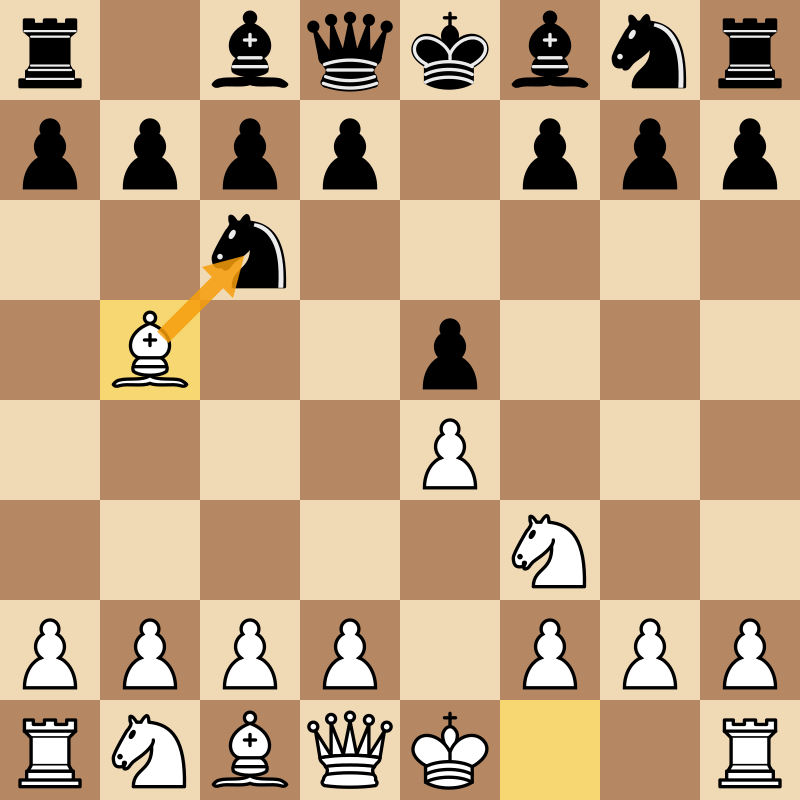
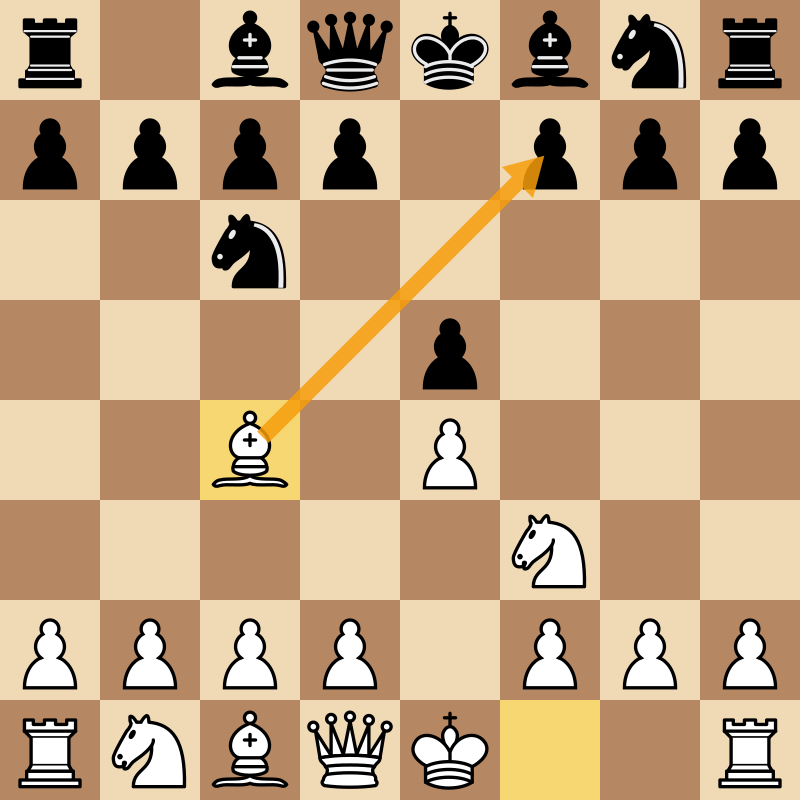
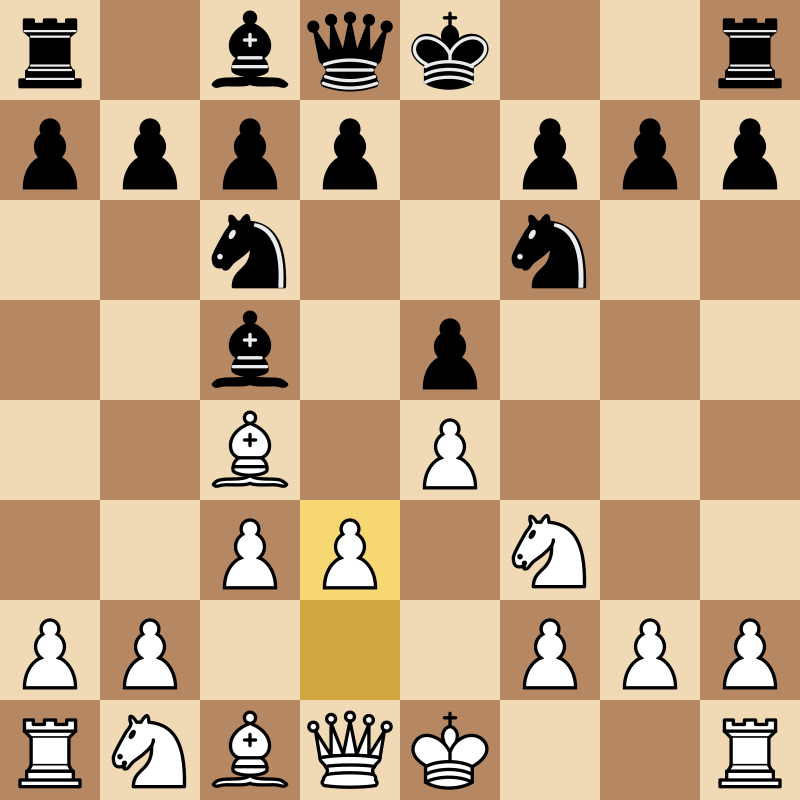
Vienna Game: An Aggressive Alternative to 2.Nf3
Learn the Vienna Game (1.e4 e5 2.Nc3): the Vienna Gambit with f4, the Bc4 lines and the copycat trap, plans against ...Nf6 and ...Nc6, and key tactics.
In short
- The Vienna (1.e4 e5 2.Nc3) supports a later f4, aiming for a King's Gambit with better preparation.
- Against 2...Nf6, the Vienna Gambit (3.f4) is the most aggressive try: after 3...d5 4.fxe5, White gains space with tempo.
- Against 2...Nc6 or the copycat 2...Bc5, Bc4 and Qg4 or f4 ideas create quick threats.
- The Vienna needs less theory than the Italian or Ruy and suits attacking players.
The Vienna Game starts 1.e4 e5 2.Nc3. Instead of attacking e5 with Nf3, White develops the queen’s knight first, keeping the f-pawn free to advance. The idea is a King’s Gambit with better preparation: the knight already supports e4, so when f4 comes, White’s center is more stable.
It’s a great opening for attacking players who want something less theoretical than the Italian or the Ruy Lopez.
Against 2…Nf6: the Vienna Gambit
Black’s most popular reply develops and attacks e4. White’s sharpest answer is 3.f4.
The main line is 3…d5!, hitting back in the center. After 4.fxe5 Nxe4 5.Nf3, White has gained space with the e5 pawn and Black has an active knight on e4.
The trainer’s line continues 5…Be7 6.d4 O-O 7.Bd3 f5 8.exf6 Bxf6 9.O-O. Step through it on the Vienna page.
White’s plans: use the half-open f-file, aim the d3 bishop at h7, and attack on the kingside. Black, in return, has active pieces and central play.
Against 2…Nf6: the quieter 3.Bc4
3.Bc4 develops the bishop toward f7. Black’s most testing reply is 3…Nxe4!, the “fork trick”: after 4.Nxe4 d5, Black regains the piece and frees the game.
White’s sharpest answer is 4.Qh5!, threatening Qxf7#, which leads to the wild Frankenstein-Dracula Variation: 4…Nd6 5.Bb3 Nc6 6.Nb5 g6 7.Qf3 f5 8.Qd5 Qe7 9.Nxc7+ Kd8 10.Nxa8 b6.
White is up a rook, but the knight on a8 is trapped and Black’s pieces swarm around White’s queen. It’s a fascinating line, but if you want calm play, 3.g3 or 3.f4 is simpler.
Against 2…Nc6
Black develops the queen’s knight. White’s main options:
- 3.Bc4, aiming at f7, with ideas of Qg4 or f4 later.
- 3.f4, a direct gambit. After 3…exf4 4.Nf3, White aims for d4 and Bxf4.
- 3.g3, a quiet fianchetto with Bg2, Nge2 and a slow kingside plan.
The copycat trap: 2…Bc5 and 2…Nc6 with …Bc5
If Black mirrors White’s development with …Nc6 and …Bc5, White has a strong idea: Qg4, hitting g7.
1.e4 e5 2.Nc3 Nc6 3.Bc4 Bc5 4.Qg4!
Black must defend with 4…Qf6 or 4…g6 (not 4…Nf6??, which loses to 5.Qxg7). Even with correct defense, White has gained time. It’s a great example of how the copycat approach can go wrong.
Plans in the Vienna
- The f4 push. The defining idea: open the f-file and gain central space.
- Kingside attack. Bd3 or Bc4, Qe1–h4 or Qg4, and the rook on the f-file.
- The d4 break. After f4 and Nf3, d4 completes a powerful center.
- Quick development. The Vienna’s lines are tactical; being a tempo ahead matters.
Is the Vienna right for you?
The Vienna suits attacking players who want sharp, open positions with less theory than the Italian or Ruy Lopez. The trade-off is that it’s slightly less ambitious against a well-prepared opponent. We compare it with the Italian in Vienna vs Italian, and if you face it as Black, read how to beat the Vienna Game.
Practice it
Learn the Vienna Gambit line move by move on the Vienna page, then play it from memory in the trainer. Wikipedia’s Vienna Game article covers its history and many sidelines.
Practice it in Chess Opens
Learn the Vienna Gambit move by move
Step through the Vienna Gambit with the reason behind every move, then play it from memory against the trainer. Free, no sign-up.
Questions
Q1Is the Vienna Game good for beginners?
Yes. It's straightforward, has clear attacking ideas, and avoids the huge body of theory in the Ruy Lopez and Open Sicilian-style 1.e4 e5 lines. It also teaches useful lessons about the f-file and kingside attacks.
Q2What is the Vienna Gambit?
1.e4 e5 2.Nc3 Nf6 3.f4. White offers the f-pawn to open the f-file and gain central space. Unlike the King's Gambit, the knight on c3 already supports e4, which makes the gambit more solid.
Q3What is the Frankenstein-Dracula Variation?
A wild line of the Vienna: 1.e4 e5 2.Nc3 Nf6 3.Bc4 Nxe4 4.Qh5 Nd6 5.Bb3 Nc6 6.Nb5 g6 7.Qf3 f5 8.Qd5 Qe7 9.Nxc7+ Kd8 10.Nxa8 b6, where White wins a rook but Black gets a dangerous attack.
Keep reading
Ruy Lopez: The Complete Guide to the Spanish Opening
Learn the Ruy Lopez (1.e4 e5 2.Nf3 Nc6 3.Bb5): the Closed main line, Exchange, Berlin, Marshall and Open variations, plus White's plans and key traps.
Italian Game: The Complete Guide for White
Learn the Italian Game (1.e4 e5 2.Nf3 Nc6 3.Bc4): the Giuoco Pianissimo main line, plans with c3 and d3, how to meet 3...Nf6, and key traps.
Italian Game Pros and Cons: Simple, Safe, or Too Slow?
The Italian Game's pros and cons: principled development, attacking chances and manageable theory, versus slow main lines and solid Black defenses.