Scotch Game: Open the Center from Move Three
Learn the Scotch Game (1.e4 e5 2.Nf3 Nc6 3.d4): the Mieses Variation, the Classical with 4...Bc5, the Scotch Gambit, and White's plans for open, active play.
In short
- The Scotch (3.d4) opens the center immediately, leading to open positions with fast development.
- Against 4...Nf6, the Mieses Variation (5.Nxc6 bxc6 6.e5) gains space and damages Black's pawns.
- Against 4...Bc5, White chooses between 5.Be3, 5.Nxc6 and 5.Nb3.
- The Scotch Gambit (4.Bc4) and Göring Gambit (4.c3) are sharper ways to play for the initiative.
The Scotch Game is the most direct way to play 1.e4 e5. Instead of the slow buildup of the Italian or the Ruy Lopez, White opens the center on move three: 1.e4 e5 2.Nf3 Nc6 3.d4. After 3…exd4 4.Nxd4, White has a knight in the center, open lines for every piece, and a game that starts fast.
Garry Kasparov brought the Scotch back to the top level in the 1990s, and it has been a respected alternative to the Ruy Lopez ever since.
Against 4…Nf6: the Mieses Variation
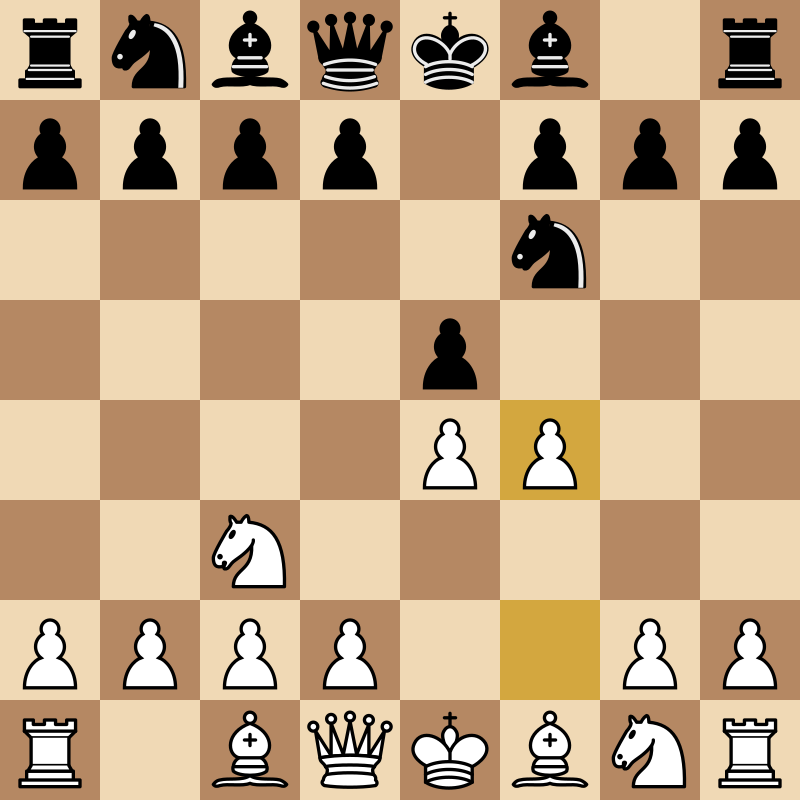
Black develops and attacks e4. White’s main answer trades knights and kicks Black’s knight with 5.Nxc6 bxc6 6.e5.
The main line continues 6…Qe7 7.Qe2 Nd5 8.c4 Ba6 9.b3.
The positions are unusual: White’s pieces are temporarily awkward (the queen on e2 blocks the f1 bishop), but Black’s pawn structure is damaged and White has a space advantage with the e5 pawn. Step through it on the Scotch Game page.
Against 4…Bc5: the Classical
Black develops the bishop with tempo on the d4 knight. White has three main options:
- 5.Be3, defending the knight. After 5…Qf6 6.c3 Nge7, Black puts pressure on d4 and both sides develop quickly.
- 5.Nxc6, trading knights. After 5…Qf6 6.Qd2 dxc6 7.Nc3, White has a solid, healthy position.
- 5.Nb3, retreating with tempo on the bishop. A positional choice.
Against 4…Qh4: the Steinitz
A provocative move: Black’s queen hits e4 and f2. White usually plays 5.Nc3 or 5.Nb5, developing with tempo and aiming to punish the early queen sortie. Know the basics if you play the Scotch; club players use it as a surprise.
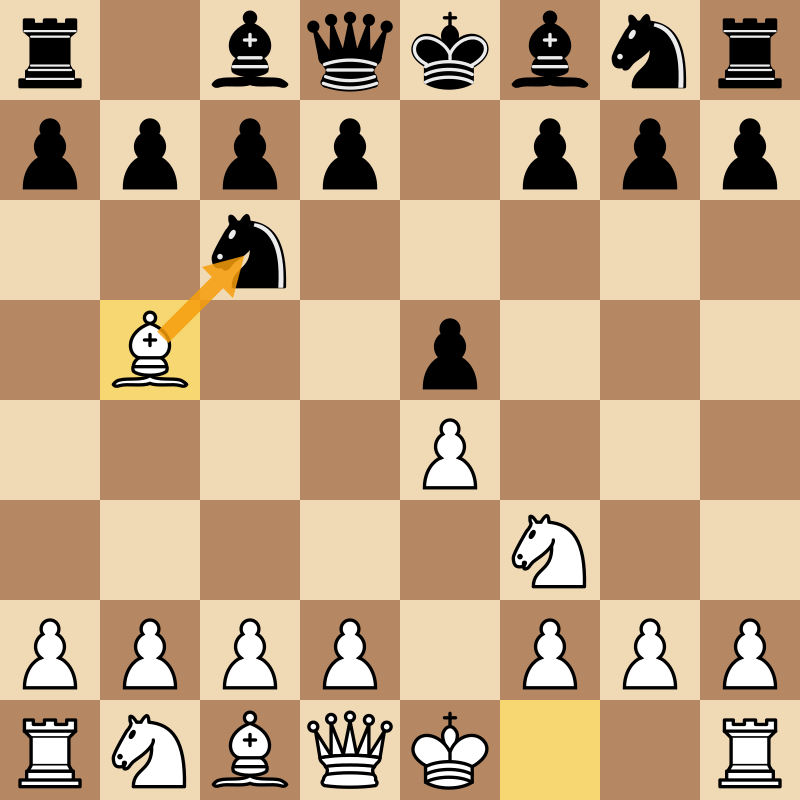
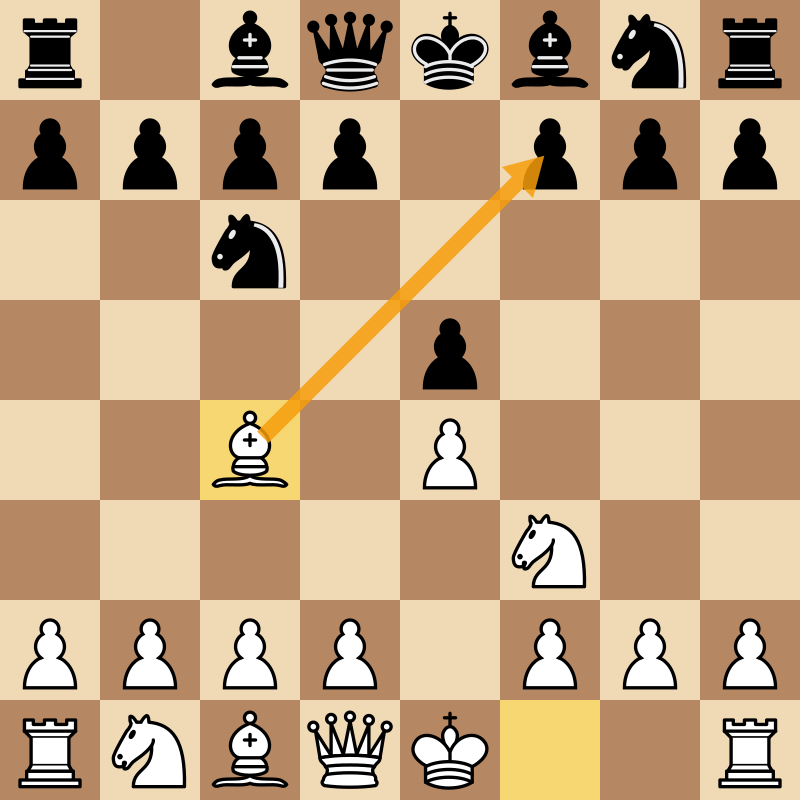
The Scotch Gambit: 4.Bc4
Instead of recapturing, White develops the bishop and offers a pawn: 1.e4 e5 2.Nf3 Nc6 3.d4 exd4 4.Bc4. Black often transposes to the Two Knights with 4…Nf6, or plays 4…Bc5, leading to the Max Lange Attack after 5.O-O Nf6 6.e5. Both lines are on the Scotch Gambit page.
The Göring Gambit: 4.c3
4.c3 offers a pawn (or two) for rapid development. If Black accepts with 4…dxc3 5.Nxc3, White has a big lead in development, similar to the Smith-Morra against the Sicilian. Black’s simplest answer is to decline with 4…d5.
White’s plans in the Scotch
- Fast development. The open center rewards being first to castle and bring rooks to the center.
- Use the e5 pawn. In the Mieses, e5 cramps Black’s kingside and the knight on d5 can be chased with c4.
- Exploit Black’s damaged pawns. After Nxc6 bxc6, Black’s c-pawns can become targets in the endgame.
- The f4–f5 advance in some lines, attacking Black’s kingside.
Common Scotch mistakes
- Letting Black develop with tempo. After 4.Nxd4, Black’s pieces hit the d4 knight; don’t lose time moving it repeatedly.
- Underestimating …Qh4. The early queen move is objectively dubious but tricky.
- Rushing in the Mieses. The position needs untangling before attacking.
Is the Scotch right for you?
The Scotch suits players who want open, active positions and less theory than the Ruy Lopez. It’s less flexible than the Italian (the center opens early, so there’s less room for slow plans), but it’s a great choice for players who like dynamic games. Compare it with other 1.e4 e5 choices in the best chess openings for White, and see the Italian’s alternative approach in the Italian Game guide.
Practice it
Learn the Mieses Variation move by move on the Scotch Game page and play it from memory in the trainer. Wikipedia’s Scotch Game article covers the full history.
Practice it in Chess Opens
Learn the Scotch Game move by move
Step through the Scotch Game with the reason behind every move, then play it from memory against the trainer. Free, no sign-up.
Also in this article: Scotch Gambit
Questions
Q1Is the Scotch Game good for beginners?
Yes. It's direct, opens lines quickly and teaches active piece play. The main lines are less theoretical than the Ruy Lopez, and the plans are clear.
Q2Why did Kasparov play the Scotch?
Garry Kasparov revived the Scotch at the top level in the 1990s as a way to avoid the deeply analyzed Ruy Lopez while still getting an active, open position with real chances for an advantage.
Q3What's the difference between the Scotch Game and the Scotch Gambit?
In the Scotch Game, White recaptures the d4 pawn immediately with 4.Nxd4. In the Scotch Gambit, White plays 4.Bc4 instead, developing and letting Black keep the pawn for a while in exchange for quick development.
Keep reading
Vienna Game: An Aggressive Alternative to 2.Nf3
Learn the Vienna Game (1.e4 e5 2.Nc3): the Vienna Gambit with f4, the Bc4 lines and the copycat trap, plans against ...Nf6 and ...Nc6, and key tactics.
Ruy Lopez: The Complete Guide to the Spanish Opening
Learn the Ruy Lopez (1.e4 e5 2.Nf3 Nc6 3.Bb5): the Closed main line, Exchange, Berlin, Marshall and Open variations, plus White's plans and key traps.
Italian Game: The Complete Guide for White
Learn the Italian Game (1.e4 e5 2.Nf3 Nc6 3.Bc4): the Giuoco Pianissimo main line, plans with c3 and d3, how to meet 3...Nf6, and key traps.