Scandinavian Defense: A Complete Guide to 1...d5
Learn the Scandinavian Defense (1.e4 d5): the 3...Qa5 main line, the modern 3...Qd6, the 2...Nf6 gambit-style lines, Black's plans, and traps to avoid.
In short
- The Scandinavian (1.e4 d5) challenges White's center immediately and can't be avoided by White.
- After 2.exd5 Qxd5 3.Nc3, the queen retreats to a5, d6 or d8; ...Qa5 is the classical main line.
- Black's setup: ...Nf6, ...c6, ...Bf5 (or ...Bg4) and ...e6, a solid 'Caro-Kann-like' structure.
- Watch for White's Bd2 and Nd5 tricks against the a5 queen, and for Ne5 and g4 against the f5 bishop.
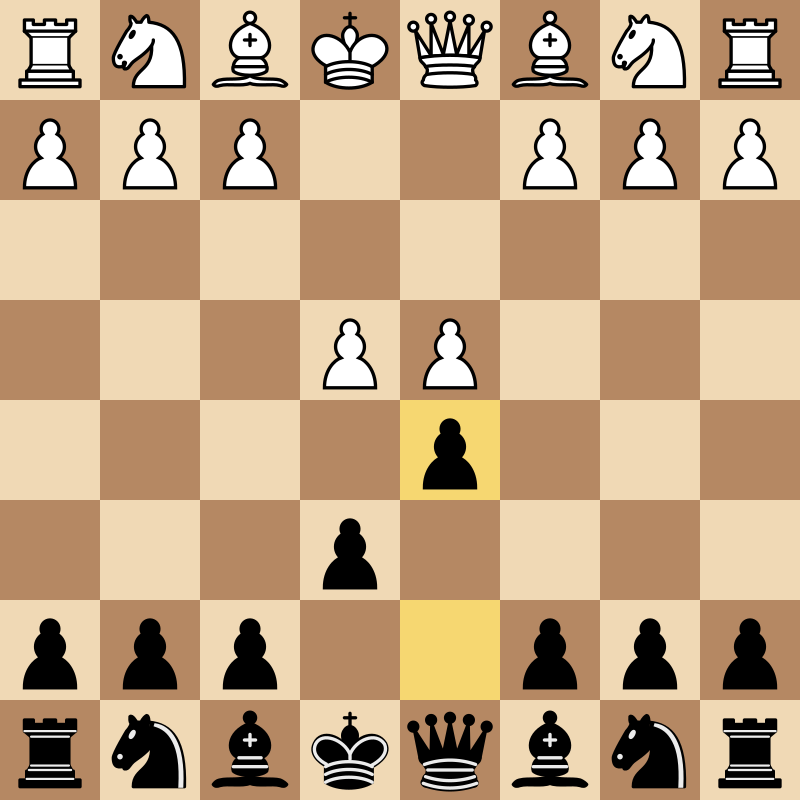
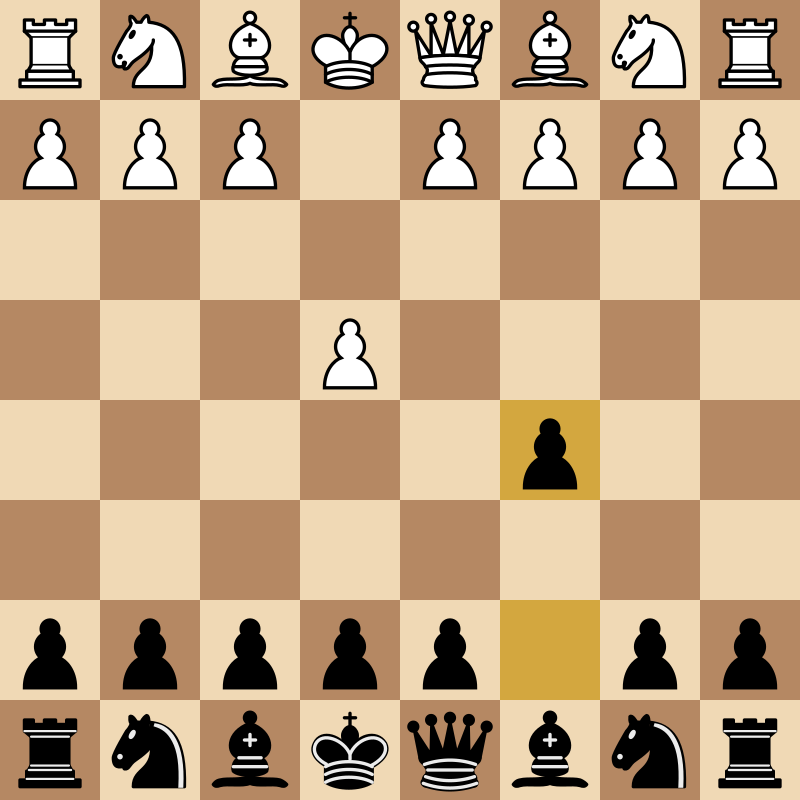
The Scandinavian Defense is the most direct answer to 1.e4. Black attacks the e4 pawn on move one with 1…d5, forcing White to decide immediately. It’s simple, solid, and impossible for White to avoid, which makes it a favorite of practical players who don’t want to learn a lot of theory.
The main line: 2.exd5 Qxd5 3.Nc3
White almost always captures, and Black recaptures with the queen. White then gains time by hitting it with 3.Nc3. Black chooses between three retreats.
3…Qa5: the classical main line
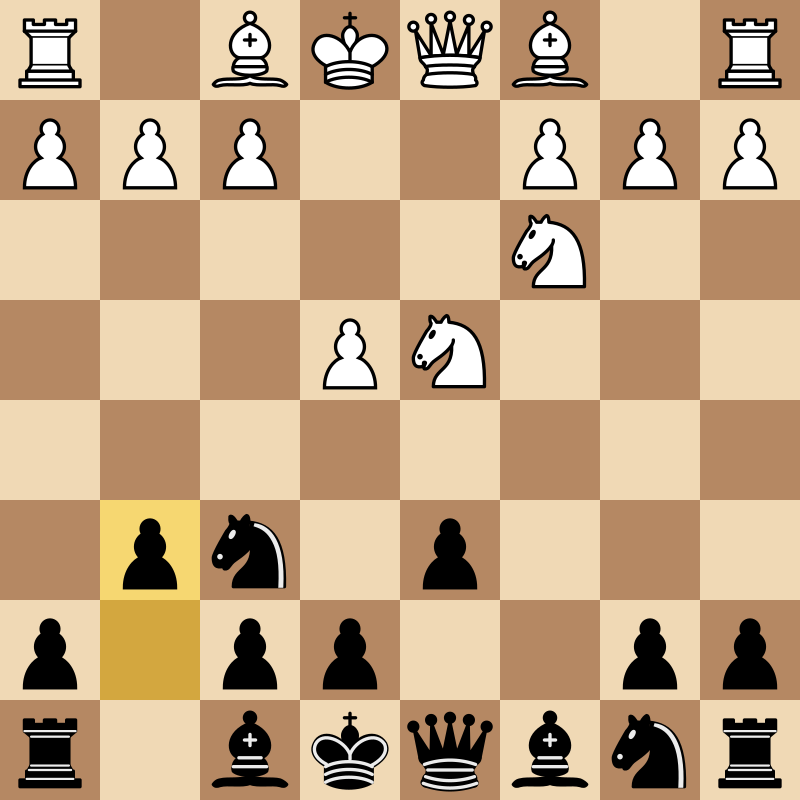
On a5, the queen is safe, pins the c3 knight against the king (after d4), and eyes the queenside. The trainer’s main line continues 4.d4 Nf6 5.Nf3 c6 6.Bc4 Bf5 7.Bd2 e6.
Black’s setup is solid: the c6 pawn gives the queen a retreat on c7 and controls d5 and b5; the f5 bishop develops outside the pawn chain; …e6, …Nbd7, …Bb4 or …Be7 and castling follow. Step through it on the Scandinavian page.
3…Qd6: the modern choice
The queen goes to d6, where it’s harder for White to attack with Bd2 and Nd5 tricks, and it can come to the kingside. Black follows with …Nf6, …a6 and …c6 or …g6.
3…Qd8: the solid retreat
The queen goes home. Black has lost time, but the position is extremely solid, with no target for White’s pieces. Black plays …Nf6, …c6 and …Bf5 or …g6 and …Bg7.
The Modern Scandinavian: 2…Nf6
Instead of taking with the queen, Black develops and plans to take back on d5 with the knight.
White can try to hold the pawn with 3.c4 (Black answers with 3…c6, a gambit, or 3…e6) or play 3.Bb5+ with ideas of keeping material. The most common reply is 3.d4, after which Black can recapture with 3…Nxd5 or play the sharp 3…Bg4.
Black’s plans
- Develop quickly around the queen. …Nf6, …Bf5 or …Bg4, …e6, …c6, castle.
- Hit d4. With …c5 or by pinning the f3 knight with …Bg4.
- Castle queenside sometimes. With the queen on a5 and the bishop on f5, …O-O-O is a common, aggressive option.
- Trade into a good endgame. The Scandinavian’s structure is healthy, like the Caro-Kann’s.
Traps and tricks to avoid
The Bd2 and Nd5 discovered attack
With Black’s queen on a5 and White’s bishop on d2, a knight move from c3 can uncover an attack on the queen. A typical example: if Black allows Nd5 (when the c3 knight is no longer pinned), the queen on a5 is hit by the d2 bishop and the knight can also hit c7.
Lesson: after Bd2, make sure the queen has a safe square and c7 is covered (…c6 helps).
Ne5 and g4 against the f5 bishop
White sometimes plays Ne5 and g4, chasing the f5 bishop. Keep a retreat to g6 ready (that’s often a reason for …e6 and …Nbd7 to come early, to challenge e5).
Common Scandinavian mistakes
- Moving the queen too many times. After its first two moves, develop the other pieces.
- Forgetting …c6. It gives the queen a retreat on c7 and covers b5 and d5.
- Leaving the f5 bishop without a retreat. Watch for g4.
- Allowing Nb5 tricks. With the queen on a5 or d6, a knight on b5 can hit c7 and the queen.
Is the Scandinavian right for you?
The Scandinavian suits practical players who want a simple, reliable defense to 1.e4 that White can’t sidestep. Its main drawback is the time spent on queen moves. Compare it with its closest relative in Scandinavian vs Caro-Kann, and for White’s best tries, read how to beat the Scandinavian Defense.
Practice it
Learn the …Qa5 main line on the Scandinavian page and play it from memory in the trainer. Wikipedia’s Scandinavian Defense article covers the history and the sidelines.
Practice it in Chess Opens
Learn the Scandinavian Defense move by move
Step through the Scandinavian Defense with the reason behind every move, then play it from memory against the trainer. Free, no sign-up.
Questions
Q1Is the Scandinavian Defense good for beginners?
Yes. It's one of the easiest defenses to learn: White can't avoid it, the setup is the same in most games, and the plans are simple. The main cost is moving the queen early, which is manageable if you know where it belongs.
Q2Isn't moving the queen early bad?
Usually, yes, but in the Scandinavian the queen's moves are well understood. After ...Qa5 or ...Qd6, it's safe and active, and Black develops quickly around it. White's extra tempo from Nc3 is real but small.
Q3What is the Modern Scandinavian?
The line 1.e4 d5 2.exd5 Nf6, where Black recaptures the pawn later with the knight instead of the queen. It leads to more dynamic play and some gambit-style lines.
Keep reading
Sicilian Dragon: A Complete Guide for Aggressive Players
Learn the Sicilian Dragon: the setup with ...g6 and ...Bg7, the Yugoslav Attack race, the ...Rxc3 exchange sacrifice, and White's quieter alternatives.
French Defense: A Complete Guide for Black
Learn the French Defense (1.e4 e6 2.d4 d5): the Advance, Winawer, Classical, Tarrasch and Exchange variations, Black's pawn breaks, and the bad bishop.
Sicilian Defense: A Beginner's Guide to the Main Lines
Understand the Sicilian Defense (1.e4 c5): why it works, the Najdorf, Dragon, Sveshnikov and ...e6 systems, the anti-Sicilians, and which line to choose.