French Defense: A Complete Guide for Black
Learn the French Defense (1.e4 e6 2.d4 d5): the Advance, Winawer, Classical, Tarrasch and Exchange variations, Black's pawn breaks, and the bad bishop.
In short
- The French (1.e4 e6 2.d4 d5) builds a solid pawn chain and counter-attacks White's center.
- Black's two pawn breaks are ...c5 (hitting d4) and ...f6 (hitting e5).
- Against the Advance, attack the base of White's chain on d4 with ...c5, ...Nc6 and ...Qb6.
- The light-squared bishop is Black's problem piece; trade it, reroute it, or open the position to activate it.
The French Defense is the opening of counter-attackers. Black lets White take space in the center, builds a sturdy pawn chain, and then hits back at the right moment. It has been a favorite of tough, strategic fighters such as Mikhail Botvinnik, Viktor Korchnoi and Wolfgang Uhlmann.
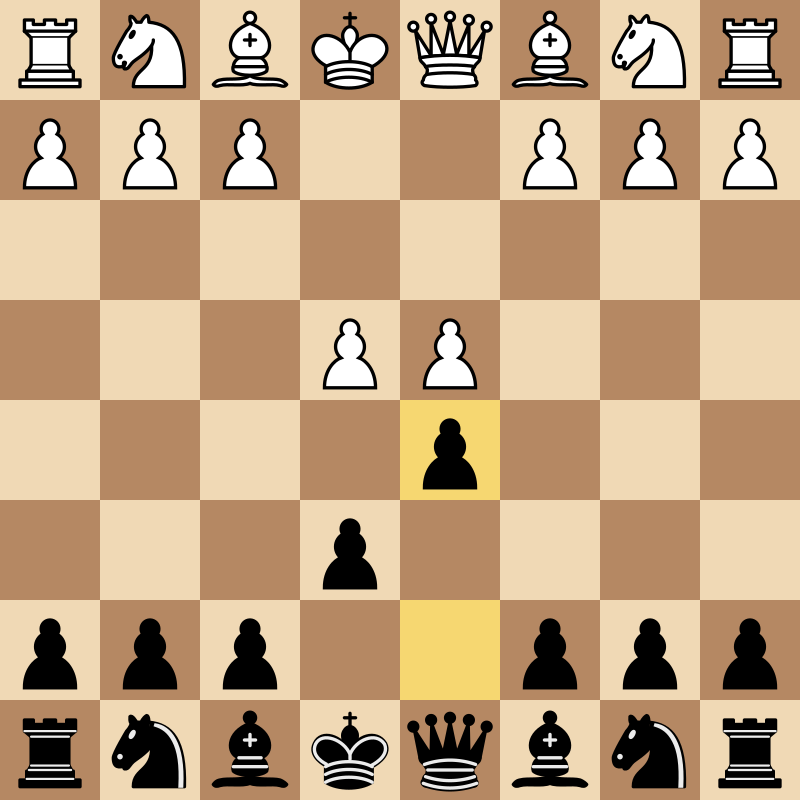
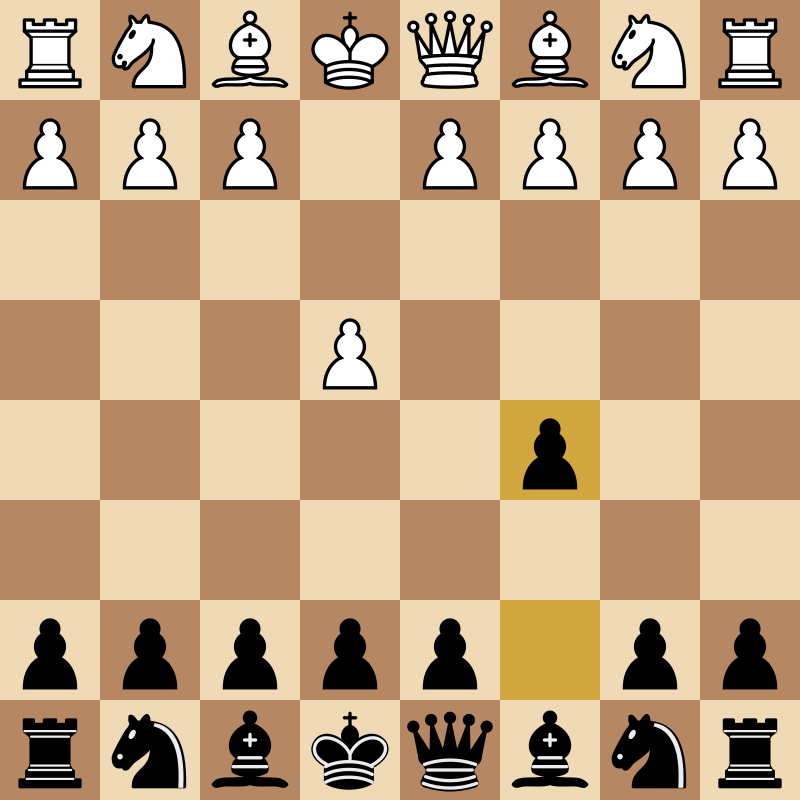
After 1.e4 e6 2.d4 d5, Black challenges White’s e4 pawn immediately, supported by the pawn on e6.
White now has to decide what to do with the e4 pawn: advance it (3.e5), defend it (3.Nc3 or 3.Nd2), or exchange it (3.exd5). Each choice leads to a different kind of game.
The Advance Variation: 3.e5
White grabs space and locks the center. Black’s response is the core French plan: attack the base of White’s pawn chain. White’s chain runs d4–e5; its base is d4.
Black piles up on d4 with …c5, …Nc6 and …Qb6, and often adds …Nge7–f5. White defends with c3, Nf3 and sometimes Be2 or Bd3.
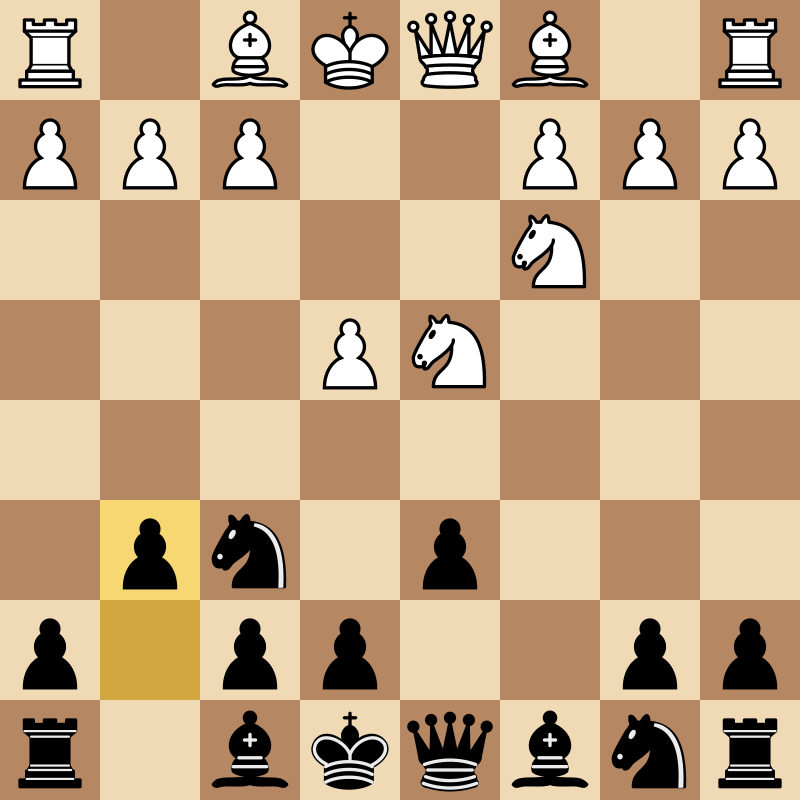
In the trainer’s main line, Black then gains queenside space: 6.a3 c4 7.Nbd2 Na5, eyeing the b3 square.
Step through it with every move explained on the French Defense page.
The Winawer Variation: 3.Nc3 Bb4
Black pins the c3 knight and threatens to win e4. The main line is 4.e5 c5 5.a3 Bxc3+ 6.bxc3 Ne7.
It’s a deeply unbalanced position:
- White has the bishop pair and attacking chances on the dark squares of Black’s kingside (Qg4 is a typical move).
- Black has a better pawn structure (White’s c-pawns are doubled) and counterplay on the queenside and in the center.
The sharpest line is the Poisoned Pawn, 7.Qg4, where White grabs g7 and h7 and Black counter-attacks. The trainer covers the calmer 7…O-O.
The Classical: 3.Nc3 Nf6
Black develops and attacks e4. White can play 4.Bg5, pinning the knight, or 4.e5 Nfd7 (the Steinitz Variation), gaining space.
The Tarrasch: 3.Nd2
White supports e4 with the knight from d2, avoiding the Winawer pin. Black’s main replies are 3…c5, opening the center, and 3…Nf6, which leads to Advance-like structures after 4.e5 Nfd7.
The Exchange: 3.exd5 exd5
White releases the tension. The structure becomes symmetrical, and Black’s light-squared bishop is suddenly free. Black is very comfortable here; the game is about piece activity. Many French players are happy to see the Exchange.
The French’s pawn breaks
Almost every French middlegame revolves around two breaks:
- …c5, hitting d4. Played in almost every variation, often on move three or four.
- …f6, hitting e5. Used once White’s center is committed, to open the f-file for Black’s rook.
Dealing with the bad bishop
Black’s light-squared bishop on c8 is blocked by pawns on e6 and d5. There are three ways to deal with it:
- Trade it: …b6 and …Ba6, swapping it for White’s good bishop.
- Reroute it: …Bd7–e8–h5 or …Bd7–b5 to reach an open diagonal.
- Free it: open the position with …f6 or …c5 so the bishop gets air.
Common French Defense mistakes
- Waiting too long to play …c5. Without it, White’s space advantage grows unchecked.
- Ignoring the kingside. In the Advance and Winawer, White’s attack with Bd3, Qg4 or h4–h5 can be fast. Keep enough defenders near your king.
- Grabbing d4 carelessly. The Milner-Barry Gambit punishes greedy …Nxd4 and …Qxd4 when White’s development is far ahead.
- Playing passively. The French is a counter-attacking defense. If you aren’t challenging White’s center, you’re just cramped.
Is the French right for you?
The French suits you if you like solid structures, long-term plans and counter-attacking chances, and don’t mind a cramped position early. Compare it with its closest relative in Caro-Kann vs French, and read French Defense pros and cons for an honest assessment. For the middlegame plans in depth, see French Defense plans.
Practice it
Learn the Advance and Winawer lines on the French Defense page, then play them from memory in the trainer. For history and more variations, see Wikipedia’s French Defence article.
Practice it in Chess Opens
Learn the French Defense move by move
Step through the French Defense with the reason behind every move, then play it from memory against the trainer. Free, no sign-up.
Questions
Q1Is the French Defense good for beginners?
It's a reasonable choice for patient players. The French teaches pawn chains and pawn breaks very well, but Black often has a cramped position early on and must know when to strike with ...c5 or ...f6.
Q2What is the 'bad bishop' in the French Defense?
Black's light-squared bishop on c8. With pawns on e6 and d5 fixed on light squares, the bishop has little scope. Black solves it by trading it (...b6 and ...Ba6), rerouting it (...Bd7–e8–h5), or opening the position with pawn breaks.
Q3What is the sharpest line of the French Defense?
The Winawer Variation (3.Nc3 Bb4), especially the Poisoned Pawn line with 7.Qg4, where White grabs kingside pawns and Black counter-attacks in the center. It's one of the most double-edged openings in chess.
Keep reading
Caro-Kann vs French Defense: Which Should You Play?
Caro-Kann vs French Defense compared: pawn structures, the bad bishop, sharpness, theory, and White's main tries, to help you pick the right defense to 1.e4.
Sicilian Dragon: A Complete Guide for Aggressive Players
Learn the Sicilian Dragon: the setup with ...g6 and ...Bg7, the Yugoslav Attack race, the ...Rxc3 exchange sacrifice, and White's quieter alternatives.
Sicilian Defense: A Beginner's Guide to the Main Lines
Understand the Sicilian Defense (1.e4 c5): why it works, the Najdorf, Dragon, Sveshnikov and ...e6 systems, the anti-Sicilians, and which line to choose.