Colle System: A Simple, Dangerous Opening for White
Learn the Colle System: the d4, Nf3, e3, Bd3, c3, Nbd2 setup, the e4 break, the Colle-Zukertort with b3 and Bb2, and how to handle Black's main defenses.
In short
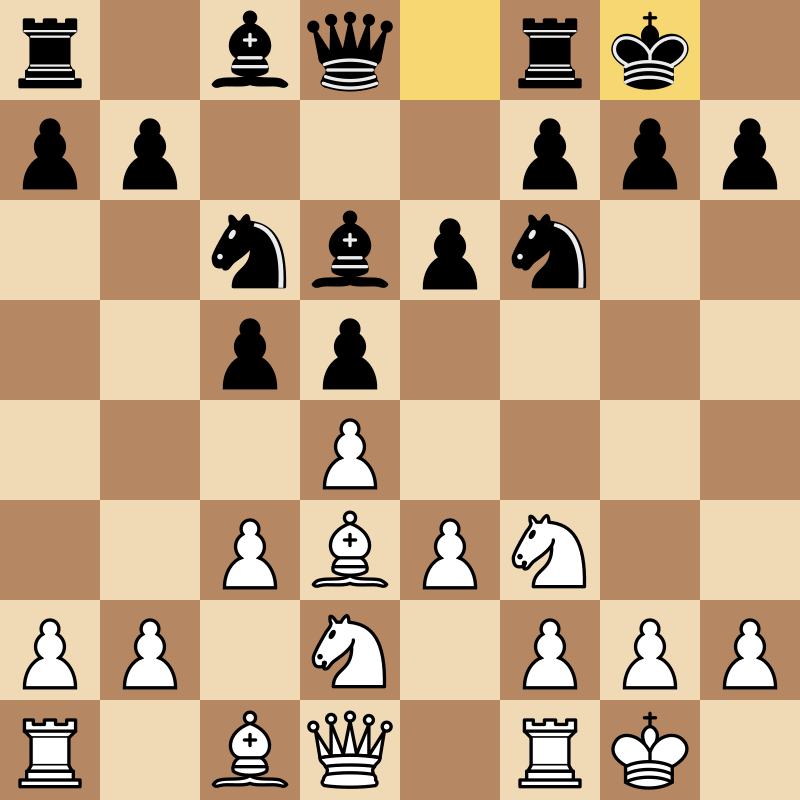
- The Colle is a system: d4, Nf3, e3, Bd3, c3, Nbd2 and castling against almost any ...d5 setup.
- Its main plan is the e3–e4 break, often followed by e5 and a kingside attack.
- The Colle-Zukertort (b3 and Bb2 instead of c3) aims for Ne5 and f4.
- The Colle's weak point is the c1 bishop; if Black stops e4, White's position can become passive.
The Colle System is one of the simplest openings in chess. White plays d4, Nf3, e3, Bd3, c3, Nbd2 and castles, almost regardless of what Black does, and then breaks open the center with e4. It looks quiet, but many Colle games end with a sudden kingside attack once that break lands.
Named after the Belgian master Edgar Colle, who used it in the 1920s, and popularized by George Koltanowski, it’s still a favorite of club players who want a reliable setup with very little theory.
The setup
- d4 and e3 build a solid center; the e3 pawn will later go to e4.
- Bd3 aims at h7, Black’s kingside.
- c3 supports d4 and gives the queen access to c2.
- Nbd2 supports e4.
- Nf3 controls e5.
The one piece that waits is the c1 bishop. In the Colle, it stays home until e4 opens the center (or, in the Zukertort version, it goes to b2).
The main plan: the e4 break
Everything White does prepares e3–e4. Typical preparation: Re1 or Qc2, plus sometimes dxc5 to clear the d-file and open lines.
After e4, White often plays e5, kicking the f6 knight away from the kingside. Then White’s bishop on d3, queen (Qc2 or Qe2) and knight (Ng5) can all target h7.
The Greek Gift
Because White’s bishop on d3 and knight on f3 both aim at the kingside, the Bxh7+ sacrifice (the Greek Gift) comes up often in the Colle. The pattern is Bxh7+ Kxh7, Ng5+ and Qh5 (or Qc2+). It works when Black’s f6 knight has been driven away and Black can’t easily cover g5 and h5. Always check the details before sacrificing.
The Colle-Zukertort: b3 and Bb2
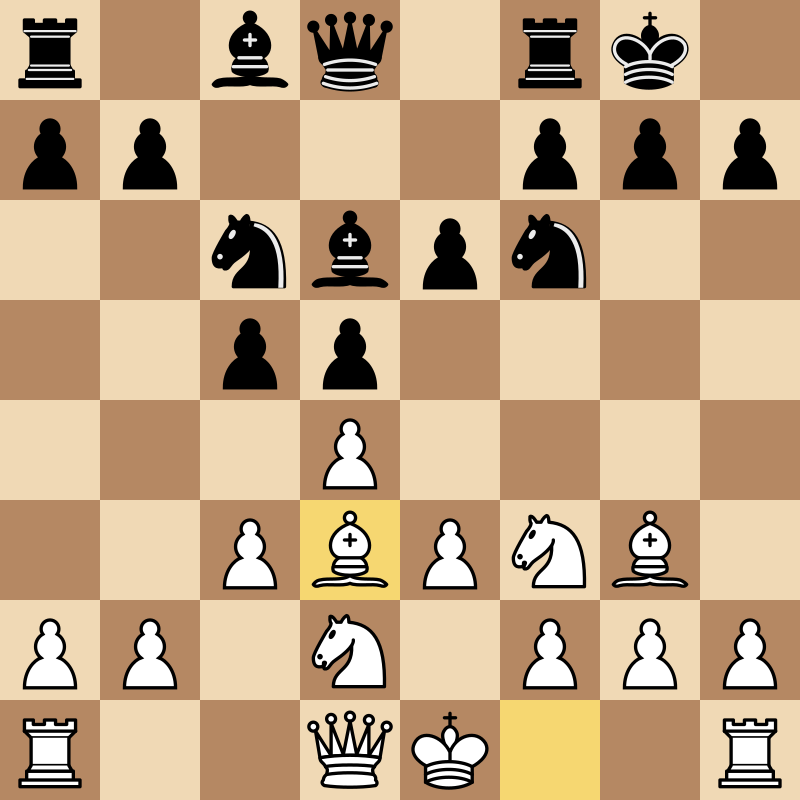
A more ambitious version. White plays b3 and Bb2 instead of c3, putting the dark-squared bishop on the long diagonal.
The main plan here is Ne5 and f4, building a strong outpost on e5 and attacking on the kingside. The b2 bishop supports d4 and e5 and can become very powerful if the long diagonal opens.
Against Black’s main setups
…d5 and …e6 (the ideal case)
This is where the Colle shines. Follow the setup and prepare e4 (or Ne5 and f4 in the Zukertort).
…d5 and …Bf5 or …Bg4
When Black develops the light-squared bishop before …e6, the Bd3 plan is less effective. White can meet …Bf5 with Bd3 to trade bishops, or switch to c4 for a Queen’s Gambit-style position.
King’s Indian setups (…g6, …Bg7, …d6)
The Colle’s e4 plan is weaker here, because Black isn’t fighting for e4 with a pawn and Black’s king is protected by the fianchetto. Consider switching to a London-style Bf4 or playing c4 for more space.
Common Colle mistakes
- Forgetting the c1 bishop. If e4 never happens, the bishop stays buried. Plan for it.
- Playing e4 without support. The break must be prepared.
- Playing the setup blindly. Against …Bf5 or King’s Indian setups, adapt.
- Allowing …e5 for free. If Black achieves …e5 first, Black takes over the center.
Colle or London?
The Colle and London share most of their moves; the difference is where the c1 bishop goes. The London’s bishop on f4 is more active, which is why the London is more popular today. The Colle is simpler and its e4 break catches many players off guard. We compare them in detail in London vs Colle, and weigh the Colle up in Colle System pros and cons.
Learn more
The trainer covers the closely related London System move by move. For the broader idea behind setups like this, read what is a system opening. Wikipedia’s Colle System article covers both the Koltanowski and Zukertort versions.
Practice it in Chess Opens
Learn the London System move by move
Step through the London System with the reason behind every move, then play it from memory against the trainer. Free, no sign-up.
Questions
Q1Is the Colle System good for beginners?
Yes. It's one of the simplest openings in chess: the first seven moves are almost always the same, and the main plan (prepare e4, then attack) is easy to understand.
Q2Who invented the Colle System?
It's named after the Belgian master Edgar Colle, who played it successfully in the 1920s. The American master George Koltanowski later popularized it, which is why the c3 version is sometimes called the Colle-Koltanowski.
Q3How do I play the Colle against the King's Indian?
The e4 plan is less effective against ...g6 and ...d6 setups. Many Colle players switch to a London-style Bf4, or play c4 against King's Indian setups. Black's fianchetto takes the sting out of the Colle's kingside attack.
Keep reading
London System vs Colle System: Which d4 System Is Better?
London System vs Colle System compared: where the dark-squared bishop goes, the plans (Ne5 and kingside attack vs the e4 break), theory, and which suits you.
Stonewall Dutch: A Complete Guide for Black
Learn the Stonewall Dutch: the ...f5, ...e6, ...d5, ...c6 setup, the e4 outpost, Black's kingside attack, the bad bishop, and how to meet White's main plans.
London System: The Complete Guide for Club Players
Learn the London System from move one: the setup, the move order, plans against every Black defense, and the traps to avoid. With diagrams.