The 8 Best Chess Openings for Beginners (and Why They Work)
The best chess openings for beginners, for White and Black: the Italian, London, Queen's Gambit, Caro-Kann and more, with diagrams and simple plans.
In short
- A good beginner opening follows the opening principles: take the center, develop knights and bishops, castle early.
- Pick one opening for White, one answer to 1.e4 and one answer to 1.d4. That's a complete repertoire.
- For White: the Italian Game, London System, Queen's Gambit or Scotch. For Black: 1...e5, the Caro-Kann, the Scandinavian or the Queen's Gambit Declined.
- Avoid openings that only work if your opponent falls for a trap. They stop working as soon as you play stronger players.
Ask ten coaches for the best chess openings for beginners and you’ll get ten slightly different lists. But almost every list will have the same things in common: openings that follow the basic principles, don’t require pages of memorized theory, and lead to positions with obvious plans.
That’s exactly how we picked the eight openings below: four for White and four for Black. Each one comes with the main moves, a diagram, the plan you should follow, and the trap to watch for. Pick one for White, one against 1.e4 and one against 1.d4, and you’ll have a complete beginner repertoire.
What makes an opening good for beginners?
Before the list, it’s worth knowing why these openings work, because the same reasons will help you judge any opening you come across.
- It follows the opening principles. Control the center with pawns, develop knights and bishops quickly, castle, and connect your rooks. If you haven’t read them yet, our guide to chess opening principles covers all ten.
- It has clear plans. Knowing what to do after move 8 matters more than knowing move 15 of a sideline.
- It’s hard to blow up. Beginner games are decided by tactics. An opening that keeps your king safe and your pieces protected removes a lot of early losses.
- It teaches you something. The best first openings build the skills you’ll need later: piece activity, pawn breaks, attacking the king.
Best openings for White
1. Italian Game
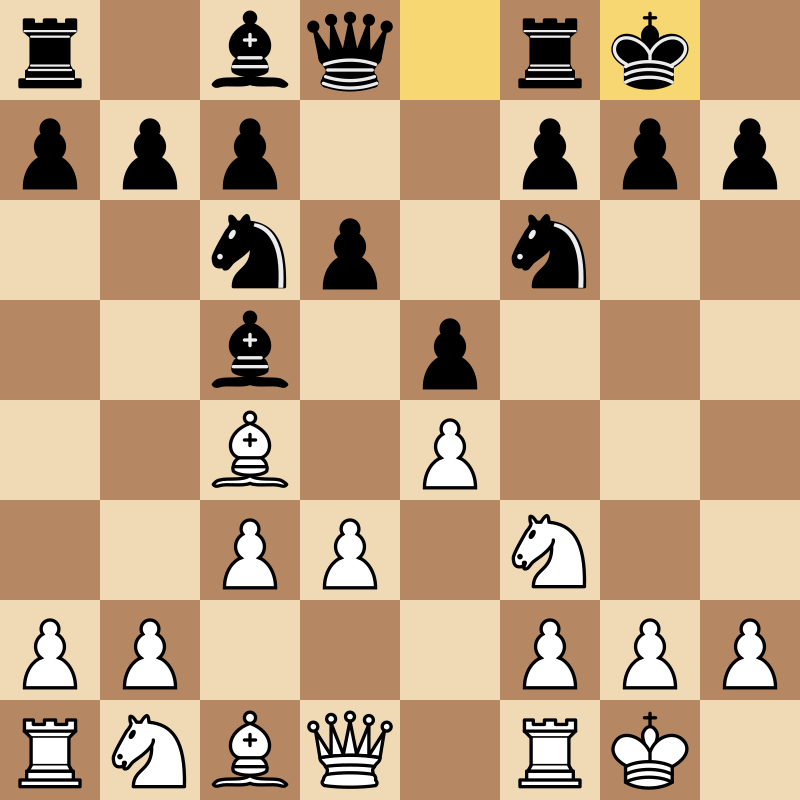
The Italian Game is the classic first opening, and for good reason. After 1.e4 e5 2.Nf3 Nc6 3.Bc4, White has a pawn in the center, a knight attacking e5, and a bishop aimed straight at f7, the weakest square in Black’s position because only the king defends it.
The plan: play c3 and d3 for a solid center, castle, put a rook on e1, and only then think about d4. This slow version (the Giuoco Pianissimo) is the main line at every level today. Later, the knight from b1 often travels d2–f1–g3 to join an attack on the kingside.
Why beginners love it: every move makes sense, and the attacking ideas against f7 teach you how to go after a king. Our complete Italian Game guide goes deeper, and you can step through the main line with explanations on the Italian Game page.
2. London System
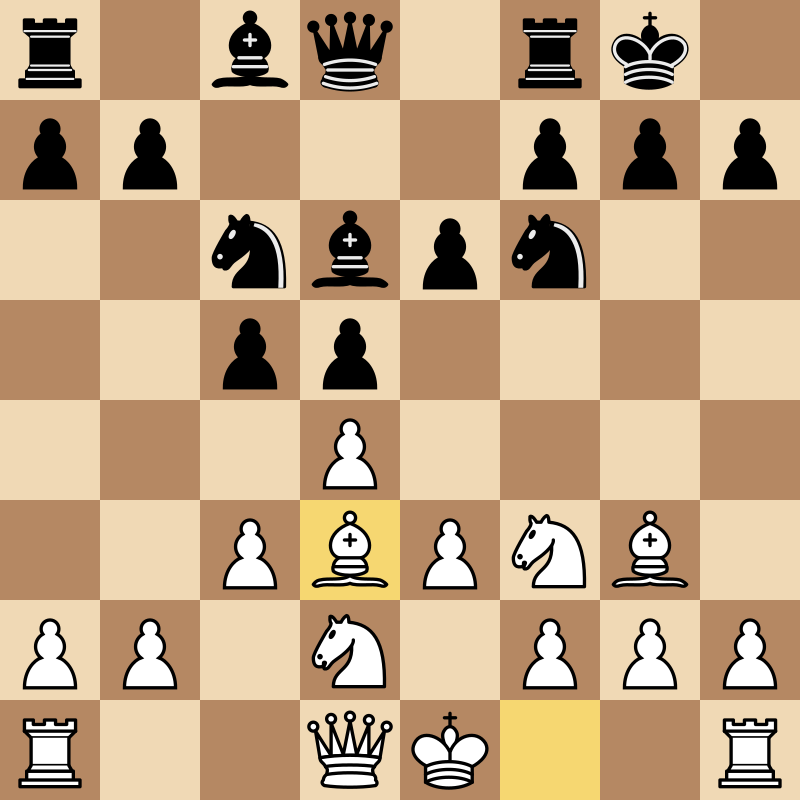
The London is the opposite kind of opening: instead of reacting to your opponent, you build the same setup almost every game. 1.d4, 2.Bf4, 3.e3, 4.Nf3, 5.c3, 6.Bd3, 7.Nbd2 and castle.
The plan: keep the pyramid of pawns on c3, d4 and e3, put a knight on e5 when you can, and attack on the kingside with Qf3–h3 or a pawn push with g4. When Black plays …Bd6 to trade your dark-squared bishop, the move Bg3 keeps it.
Why beginners love it: very little to memorize and almost no way to lose quickly. The catch: it can make you comfortable in one kind of position. Read London System pros and cons before you commit, or dive into the full London guide.
3. Queen’s Gambit
1.d4 d5 2.c4 offers a pawn to pull Black’s d-pawn away from the center. It isn’t a real gambit: if Black takes with 2…dxc4, White usually gets the pawn back easily while building a big center with e4.
The plan: develop with Nc3, Nf3, Bg5 or Bf4, and e3, then use the half-open c-file and the “minority attack” (pushing the b-pawn to b5) to create weaknesses in Black’s queenside.
Why it’s great for learning: the Queen’s Gambit teaches pawn structure, which is the skill that separates 1200 players from 1600 players. See the Queen’s Gambit page for the main line explained move by move.
4. Scotch Game
The Scotch opens the center immediately: 1.e4 e5 2.Nf3 Nc6 3.d4. After 3…exd4 4.Nxd4, White has free, active pieces and a strong knight in the center.
Why it works for beginners: open positions reward the things beginners need to practice most: fast development and tactics. There’s less maneuvering than in the Italian or Ruy Lopez. Learn the main line on the Scotch Game page.
Best openings for Black
As Black you need two answers: one to 1.e4 and one to 1.d4. Here are the two best of each for beginners.
5. 1…e5 against 1.e4
The simplest answer to 1.e4 is to copy it. 1.e4 e5 claims an equal share of the center and opens lines for your queen and bishop. After 2.Nf3 Nc6 3.Bc4, the Two Knights Defense with 3…Nf6 is active and principled: you develop and immediately counter-attack e4.
What to know: after 3…Nf6, White’s sharpest try is 4.Ng5, attacking f7. Learn the response (4…d5 5.exd5 Na5) and you’ll never lose to the Fried Liver Attack. The Two Knights page walks through it.
6. Caro-Kann Defense
1.e4 c6 followed by 2…d5. The Caro-Kann is solid, logical, and very hard for beginners to attack quickly. Black challenges White’s center without weakening the king.
The plan: get the light-squared bishop out to f5 or g4 before playing …e6, then develop calmly and castle. The Caro-Kann’s pawn structure is so healthy that many endgames are good for Black. Start with our Caro-Kann guide or the Caro-Kann page.
7. Scandinavian Defense
1.e4 d5 challenges White’s center on move one. After 2.exd5 Qxd5 3.Nc3, Black moves the queen again (3…Qa5 or 3…Qd6) and develops around it.
Why beginners like it: White can’t avoid it with a fancy move order, so you get your position every game. The setup (…Qa5, …Nf6, …Bf5, …c6, …e6) is easy to remember. See the Scandinavian page.
8. Queen’s Gambit Declined
Against 1.d4, the most reliable answer is 1…d5 2.c4 e6: support d5 with a pawn and develop with …Nf6, …Be7 and castling.
The plan: finish development, then free your position with …c5 or …e5 at the right moment. The QGD has been played by world champions for over a century, so it’s not just a “beginner” opening; it’s one you can keep forever. Learn it on the QGD page.
Quick comparison
| Opening | Color | First moves | Style | Theory to learn |
|---|---|---|---|---|
| Italian Game | White | 1.e4 e5 2.Nf3 Nc6 3.Bc4 | Classical, attacking | Low |
| London System | White | 1.d4, Bf4, e3, Nf3 | Solid system | Very low |
| Queen’s Gambit | White | 1.d4 d5 2.c4 | Positional | Medium |
| Scotch Game | White | 1.e4 e5 2.Nf3 Nc6 3.d4 | Open, active | Low |
| 1…e5 (Two Knights) | Black | 1.e4 e5 … 3…Nf6 | Active | Medium |
| Caro-Kann | Black | 1.e4 c6 2.d4 d5 | Solid | Medium |
| Scandinavian | Black | 1.e4 d5 | Direct | Low |
| Queen’s Gambit Declined | Black | 1.d4 d5 2.c4 e6 | Solid, classical | Medium |
Openings to save for later
Some great openings are poor first openings because they demand a lot of memorization or punish small mistakes hard:
- Sicilian Najdorf and Dragon: fantastic, but the main lines are deep and razor-sharp. Wait until you’re comfortable with tactics.
- King’s Indian and Grünfeld: Black lets White take the center on purpose. That only works when you understand exactly how to strike back.
- King’s Gambit: fun and educational, but one wrong move can lose instantly.
You’ll find all of these in our opening library when you’re ready.
How to actually learn your new openings
Reading about an opening is the first 10%. The other 90% is playing it until the moves are automatic and the plans make sense.
- Learn the why, not just the moves. In the Chess Opens trainer, every move of every line comes with a short explanation.
- Practice from memory. Practice mode hides the moves and makes you play your side, with hints when you’re stuck.
- Play it in real games. Then go through each game afterward and find where you left the book. Our article on how to learn chess openings lays out a simple weekly routine.
The bottom line
There’s no single best chess opening for beginners, but there are openings that make learning easier. Start with the Italian Game or London System as White, 1…e5 or the Caro-Kann against 1.e4, and the Queen’s Gambit Declined against 1.d4. Learn the ideas, play them every game, and you’ll spend your time improving instead of memorizing.
Looking for more options as Black? Read our guide to the best chess openings for Black. For a broader overview of how openings are classified, Wikipedia’s chess opening article is a good starting point.
Practice it in Chess Opens
Learn the Italian Game move by move
Step through the Italian Game with the reason behind every move, then play it from memory against the trainer. Free, no sign-up.
Also in this article: London System, Queen's Gambit, Scotch Game, Two Knights Defense, Caro-Kann Defense, Scandinavian Defense, Queen's Gambit Declined
Questions
Q1What is the easiest chess opening for beginners?
For White, the Italian Game and the London System are the easiest to learn. The Italian follows every opening principle and leads to clear attacking plans; the London lets you play the same setup against almost anything. For Black, 1...e5 against 1.e4 and the Queen's Gambit Declined against 1.d4 are the most natural choices.
Q2How many openings should a beginner learn?
Three: one opening for White, one defense against 1.e4, and one defense against 1.d4. Learn the first 6–8 moves of each and, more importantly, the plans behind them. Adding more openings early on mostly adds confusion.
Q3Should beginners play gambits?
Sound gambits such as the Queen's Gambit or the Scotch Gambit are great for learning about development and initiative. Avoid dubious trap-based gambits; they win quick games against other beginners but teach habits that stop working as you improve.
Q4Is the London System good for beginners?
Yes. The London is one of the most popular beginner openings because White can aim for the same setup (d4, Bf4, e3, Nf3, c3, Bd3, Nbd2, O-O) almost every game. Its only real downside is that it can become a habit that keeps you from learning more open positions.
Keep reading
Chess Opening Principles: 10 Rules That Win More Games
The 10 chess opening principles every player should know: control the center, develop, castle, and more. Each one explained with a diagram and examples.
London System: The Complete Guide for Club Players
Learn the London System from move one: the setup, the move order, plans against every Black defense, and the traps to avoid. With diagrams.