Chess OpensOpen the trainer
1.Opening

Caro-Kann Defense

You play BlackB19SolidBeginner

Super solid and beginner-friendly. Like the French, but the light-squared bishop gets out first.

1.e4 c6 2.d4 d5 3.Nc3 dxe4 4.Nxe4 Bf5 5.Ng3 Bg6 …

Classical Variation: position after 10 moves1h2g3f4e5d6c7b8a
Classical Variation: position after 10 moves
2.Ideas

What the opening is about

Key ideas

  1. ...c6 supports ...d5 without locking in the c8 bishop.
  2. The bishop comes out to f5 before ...e6.
  3. Healthy pawn structure; Black rarely gets blown off the board.
  4. In the Advance, ...c5 attacks White's pawn chain.
3.Line 1

Line 1 of 2 · 20 moves

Classical Variation

Practice this line →
Your moves Opponent
No. White Black1
e4White grabs the center.
c6The Caro-Kann: prepares ...d5 without blocking the c8 bishop (the French's big problem).
2
d4White builds the ideal two-pawn center.
d5Black challenges e4, backed up by the c6 pawn.
3
Nc3White defends e4 with the knight.
dxe4Black trades in the center, freeing the position.
After 3…dxe4
After 3…dxe4
No. White Black4
Nxe4White recaptures with a centralized knight.
Bf5The point of the Caro-Kann: the bishop develops outside the pawn chain, hitting the knight.
5
Ng3The knight attacks the bishop.
Bg6The bishop retreats but keeps its excellent diagonal.
6
h4Threatens h5, trapping the bishop.
h6Gives the bishop a retreat square on h7.
After 6…h6
After 6…h6
No. White Black7
Nf3White develops, eyeing e5.
Nd7Stops Ne5, which would attack the g6 bishop.
8
h5Gains kingside space and pushes the bishop back.
Bh7The bishop retreats to h7, still on the b1–h7 diagonal.
9
Bd3Offers to trade off Black's good bishop.
Bxd3Black takes — no need to waste time retreating.
After 9…Bxd3
After 9…Bxd3
No. White Black10
Qxd3White recaptures with the queen.
e6Solid. Next: ...Ngf6, ...Be7 or ...Qc7, and castle.
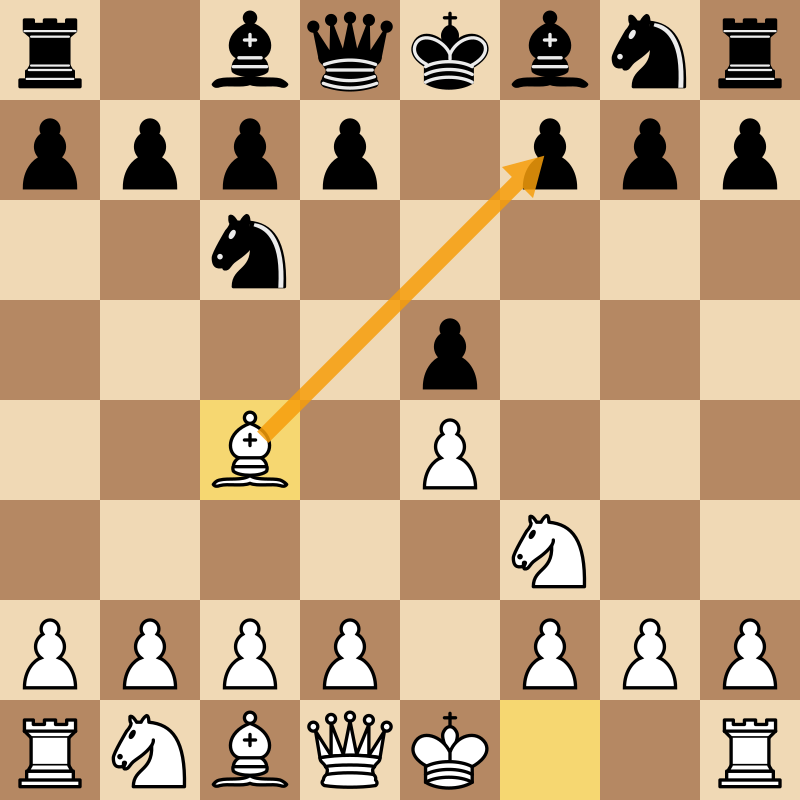
After 10…e6
After 10…e6
4.Line 2

Line 2 of 2 · 13 moves

Advance Variation

Practice this line →
Your moves Opponent
No. White Black1
e4White grabs the center.
c6The Caro-Kann: prepares ...d5 without blocking the c8 bishop (the French's big problem).
2
d4White builds the ideal two-pawn center.
d5Black challenges e4, backed up by the c6 pawn.
3
e5The Advance: White gains space and takes f6 from Black's knight.
Bf5The bishop gets out before ...e6 closes it in.
After 3…Bf5
After 3…Bf5
No. White Black4
Nf3White develops and protects e5.
e6Opens the f8 bishop and completes a solid pawn chain.
5
Be2White prepares to castle.
c5Hits the base of the chain on d4 — the same idea as in the French.
6
O-OWhite castles.
Nc6Increases the pressure on d4.
After 6…Nc6
After 6…Nc6
No. White Black7
c3White reinforces d4 with a pawn.
After 7.c3
After 7.c3
5.Play

Practice mode

Now play it without looking.

Practice mode hides the moves: you play Black, the trainer answers, and you earn up to three stars per line. 33 moves across 2 lines.

Start practicing
6.More