Chess Opening Principles: 10 Rules That Win More Games
The 10 chess opening principles every player should know: control the center, develop, castle, and more. Each one explained with a diagram and examples.
In short
- Control the center with pawns and pieces; central pieces control more squares.
- Develop knights and bishops before moving the same piece twice or bringing the queen out.
- Castle early, usually within the first ten moves, and connect your rooks.
- Don't grab pawns at the cost of development, and don't push pawns in front of your castled king without a reason.
- Principles are guidelines, not laws: concrete tactics always come first.
Opening theory is endless, but the ideas behind good openings are not. Almost every respected opening, from the Italian Game to the King’s Indian Defense, follows the same small set of principles. Learn them and you’ll play sensible moves even when you’ve never seen the position before, and you’ll understand why the openings you study work.
Here are the ten chess opening principles that matter most, in order of importance.
1. Control the center
The four central squares (d4, d5, e4 and e5) are the most valuable on the board. A piece in the center controls more squares and can reach either side of the board quickly. A knight on e4 attacks eight squares; a knight on a1 attacks two.
That’s why the most popular first moves, 1.e4 and 1.d4, put a pawn in the center and open lines for the pieces.
You can control the center with pawns (classical openings like the Italian or Queen’s Gambit) or with pieces from a distance (hypermodern openings like the King’s Indian). Either way, the center is the fight.
2. Develop your knights and bishops
Your minor pieces start on the back rank doing nothing. Each developing move brings one into play. A useful rule of thumb is knights before bishops: knights have fewer good squares (usually f3/c3 or f6/c6), while bishops can choose their diagonal once you know where the game is going.
Count your developed pieces. If your opponent has three pieces out and you have one, something has gone wrong.
3. Castle early
Castling does two jobs at once: it tucks your king behind a wall of pawns and brings a rook toward the center. Most strong players castle within the first ten moves. Leaving the king in the middle, especially once the center opens, is one of the most common ways beginners lose. Our guide on how to castle in chess covers the rules and the timing.
4. Don’t move the same piece twice
Every move spent moving an already developed piece is a move not spent developing a new one. Exceptions exist (to escape an attack, to win material, or to execute a clear plan), but “Nf3, Ng5, Nxf7, Nxh8” adventures early in the game usually backfire.
5. Don’t bring your queen out too early
The queen is your most powerful piece, which is exactly why it makes a bad early target. Every time an opponent’s minor piece attacks it with tempo, they develop and you lose time.
The Scholar’s Mate attempt (Qh5 or Qf3 with Bc4) is the classic example. It works against players who don’t see it, but against careful defense White ends up with a misplaced queen and Black develops with tempo.
6. Connect your rooks
Your development is complete when your rooks see each other along the back rank: knights and bishops out, king castled, queen moved off the first rank. Connected rooks can move to the open files where the middlegame will be decided.
7. Don’t grab pawns at the cost of development
Taking a pawn is good. Taking a pawn while your opponent develops three pieces is often not. The classic gambits (the Queen’s Gambit, the Evans Gambit, the Smith-Morra) all rely on this: they offer a pawn because the extra development and open lines are worth more than the material.
8. Don’t make too many pawn moves
Pawn moves can’t be taken back, and each one leaves squares behind it permanently weakened. In the opening, move the center pawns (usually the d- and e-pawns, sometimes the c-pawn) and the pawns needed to develop your bishops. Avoid pushing the f-, g- and h-pawns without a reason, especially in front of the king you’re about to castle.
9. Watch out for f7 and f2
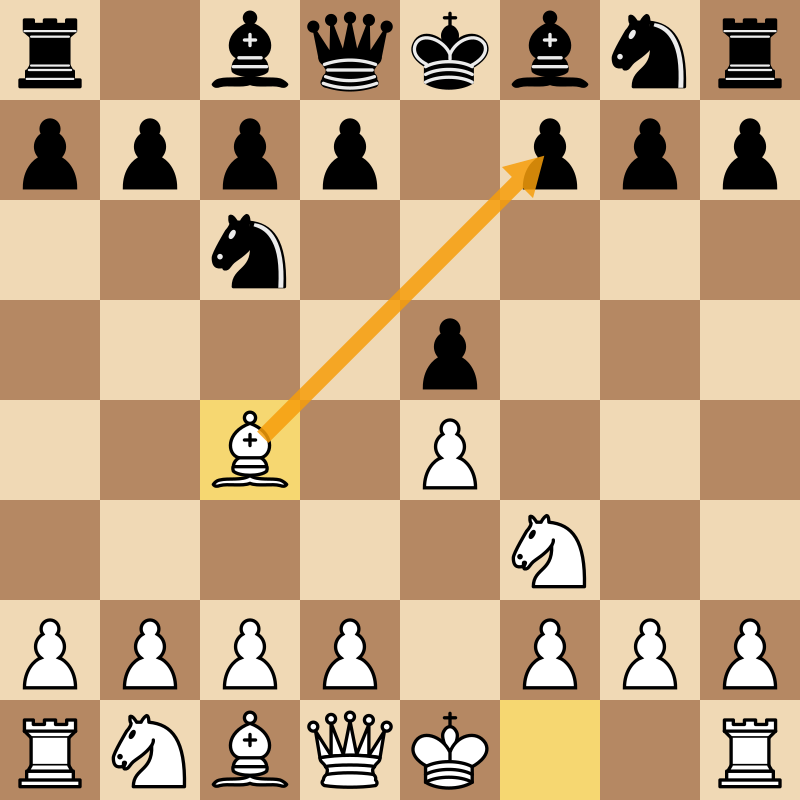
At the start of the game, f7 (and f2 for White) is defended only by the king. That makes it the target of the earliest tactics in chess: Scholar’s Mate, the Fried Liver Attack, the Légal Trap, and many more.
The cure is simple: develop, castle, and keep an eye on any piece aiming at f7. You can learn the correct defense against 4.Ng5 on the Two Knights Defense page, and our article on chess opening traps covers the most common f7 tricks.
10. Have a plan for the middlegame
The best openings don’t just get your pieces out; they point them toward a plan. In the Italian Game, White builds with c3 and d3, then aims for d4 or a kingside attack. In the Queen’s Gambit, White uses the c-file and the minority attack. Knowing the plan behind your opening matters more than knowing move 15 of the main line.
When to break the rules
Opening principles are guidelines, not laws. Strong players break them all the time, but always for a concrete reason:
- Moving a piece twice to win material or exploit a mistake.
- An early queen move when it hits something that can’t be defended.
- Delaying castling when the center is closed and the king is safe where it is.
A good habit: before breaking a principle, ask “what specifically do I gain?” If you can’t answer, follow the principle.
Practice the principles
The fastest way to absorb these ideas is to see them in real lines. Every move in the Chess Opens trainer comes with the reason it’s played, and you’ll notice the same ten principles explaining move after move. Start with the Italian Game: it follows every principle on this list.
For a broader introduction, see Wikipedia’s article on the chess opening, and when you’re ready to choose your own openings, read how to build a chess opening repertoire.
Practice it in Chess Opens
Learn the Italian Game move by move
Step through the Italian Game with the reason behind every move, then play it from memory against the trainer. Free, no sign-up.
Also in this article: Two Knights Defense
Questions
Q1What are the 3 main opening principles in chess?
Control the center, develop your pieces (knights and bishops first), and get your king safe by castling. Almost every other opening rule is a detail of one of these three.
Q2How many moves is the opening in chess?
Roughly the first 10 to 15 moves, until both sides have developed their pieces and castled. There's no fixed number; the opening ends when the development phase is over and both players start executing middlegame plans.
Q3Is it ever right to break the opening principles?
Yes, when there's a concrete reason. Strong players move a piece twice, delay castling or bring the queen out early when the position calls for it. The principles are the default; tactics and specific threats override them.
Keep reading
The 8 Best Chess Openings for Beginners (and Why They Work)
The best chess openings for beginners, for White and Black: the Italian, London, Queen's Gambit, Caro-Kann and more, with diagrams and simple plans.