How to Beat the London System: 4 Plans That Work
How to beat the London System as Black: four practical plans with ...c5 and ...Qb6, a King's Indian setup, ...Nh5 to hunt the bishop, and the ...Ne4 attack.
In short
- The London's weak spots are the b2 pawn and the f4 bishop's lack of retreat squares early on.
- Plan 1: ...d5, ...c5, ...Nc6 and ...Qb6 puts immediate pressure on b2 and d4.
- Plan 2: a King's Indian setup with ...g6, ...Bg7, ...d6 and ...e5 makes the f4 bishop hit a wall.
- Plan 3: if White forgets h3, ...Nh5 wins the bishop pair.
- Plan 4: build with ...b6, ...Bb7 and ...Ne4, then play on the kingside with ...f5.
The London System is everywhere. It’s easy for White to learn, hard to blow up, and it wins a lot of games simply because Black plays “normal” moves and lets White build the ideal setup. The way to beat the London is to play with a plan from the start.
Here are four plans that make London players uncomfortable, in order from most principled to most surprising. If you want to understand what White is trying to do first, read our London System guide.
The London’s weak spots
Every plan below targets one of three weaknesses:
- The b2 pawn. Once the c1 bishop goes to f4, b2 has lost a defender.
- The f4 bishop. It’s White’s best piece. Early on it has few retreat squares, and Black can try to trade it or chase it.
- Automatic play. London players often play the same eight moves no matter what. Black can punish moves that don’t fit the position.
Plan 1: …c5 and …Qb6, hit b2 and d4
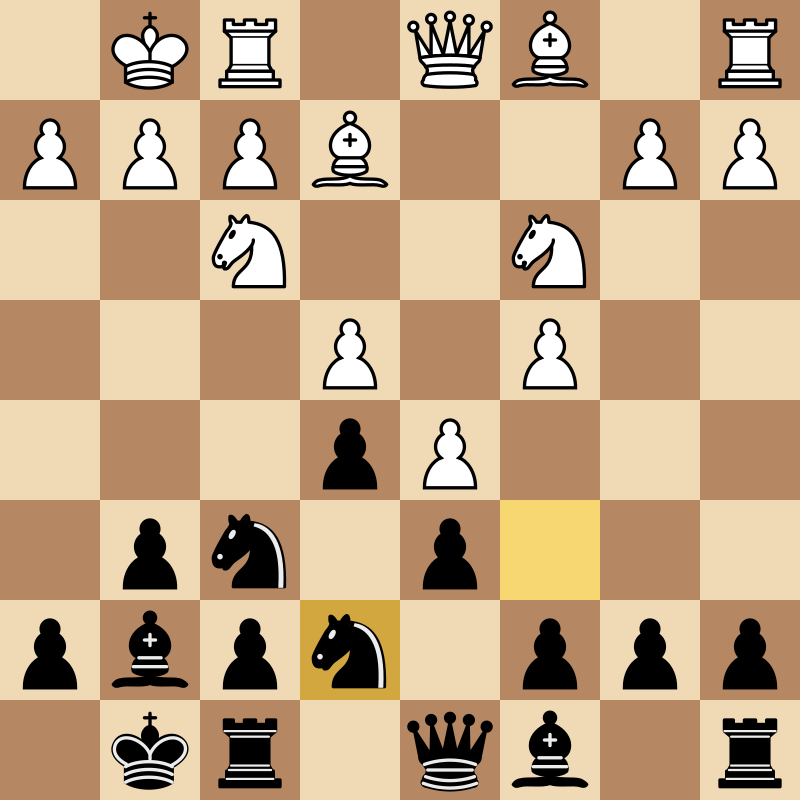
The most principled answer. Black takes the center with …d5, then attacks d4 with …c5 and …Nc6, and brings the queen to b6, where it attacks b2 and adds pressure to d4.
White’s best is 5.Qb3, offering a queen trade. Now Black has a choice:
- 5…c4 kicks the queen. After 6.Qc2 Bf5!, the bishop develops with tempo against the queen, which usually has to go back to c1, an awkward square.
- 5…Qxb3 6.axb3 leads to a quieter endgame-like position. It’s fine for Black but gives White the half-open a-file.
The point is that White must know these lines. Many London players don’t, and drop the b2 pawn or end up with a passive queen.
Plan 2: the King’s Indian setup
Against 1.d4 Nf6 2.Bf4, Black can fianchetto: …g6, …Bg7, …d6, …O-O and …e5. The bishop on g7 fights for the long diagonal, and …e5 challenges the bishop on f4 directly.
Why it works:
- The f4 bishop hits a wall. After …e5, it either trades on e5 or retreats to h2, where it does little.
- The position becomes dynamic. London players like quiet, controlled positions. A King’s Indian structure with …e5, …Re8 and kingside play is the opposite.
- The plans are clear. Black can follow up with …Re8, …exd4 to open the e-file, or …Qe7 and …Nh5. Our King’s Indian Defense guide explains the structures.
Plan 3: …Nh5, hunt the bishop
If White plays the setup moves but forgets h3, Black can play …Nh5, attacking the f4 bishop. If the bishop retreats to g3, Black takes it with …Nxg3; if it goes to g5, …h6 and …g5 chase it further.
Winning the bishop pair doesn’t win the game, but it removes White’s best piece and gives Black a long-term advantage. This is also why experienced London players play h3 early, which costs them a tempo.
Plan 4: …b6, …Bb7 and …Ne4
Against the classical London setup with …d5 and …e6, Black can fianchetto the queenside bishop and plant a knight on e4. If White chases it with Nxe4 or Bxe4, Black recaptures with the d-pawn and gets space. Black can back up the knight with …f5, building a Stonewall-style grip on e4.
This plan is slower and strategic. It suits players who like to maneuver.
Which plan should you choose?
| Plan | Style | Theory needed | Best for |
|---|---|---|---|
| …c5 + …Qb6 | Principled, direct | Medium | Players who face the London often |
| King’s Indian setup | Dynamic | Low–medium | Players who already play the KID |
| …Nh5 | Opportunistic | Low | Punishing a careless move order |
| …b6, …Ne4 | Strategic | Low | Positional players |
If you’re unsure, start with Plan 1. It puts the question to White immediately, and the ideas (pressure on b2, …Bf5 with tempo) carry over to many other d4 openings.
Practice against the London
Read the London’s main line from White’s side on the London System page; knowing what your opponent wants makes every plan above easier to execute. For Plan 2, step through the main ideas of the King’s Indian Defense. To decide whether to play the London yourself, see London System pros and cons.
The Wikipedia article on the London System also lists Black’s main tries and their history.
Practice it in Chess Opens
Learn the London System move by move
Step through the London System with the reason behind every move, then play it from memory against the trainer. Free, no sign-up.
Also in this article: King's Indian Defense
Questions
Q1What is the best defense against the London System?
There's no single refutation, but the most testing plan is ...d5 and ...c5 followed by ...Nc6 and ...Qb6, hitting b2 and d4 at once. It forces White to know the Qb3 lines instead of playing on autopilot.
Q2Can the King's Indian setup beat the London?
It's a very good practical choice. With ...g6, ...Bg7, ...d6 and ...e5, Black fights for the e5 square the London bishop wants, and the position is far more dynamic than most London players are used to.
Q3Why does the London System win so many club games?
Because Black often plays automatic developing moves and lets White build the ideal setup. Black needs a plan that creates immediate pressure, such as attacking b2 or striking with ...e5, rather than just developing.
Keep reading
King's Indian Defense Pros and Cons
The King's Indian Defense's pros and cons: winning chances, attacking play and a flexible setup, versus heavy theory, risk, and positions that go wrong fast.
Stonewall Dutch: A Complete Guide for Black
Learn the Stonewall Dutch: the ...f5, ...e6, ...d5, ...c6 setup, the e4 outpost, Black's kingside attack, the bad bishop, and how to meet White's main plans.
Queen's Gambit Declined: A Complete Guide for Black
Learn the Queen's Gambit Declined as Black: the Orthodox, Tartakower and Lasker defenses, the Exchange Variation, freeing breaks, and the Elephant Trap.